
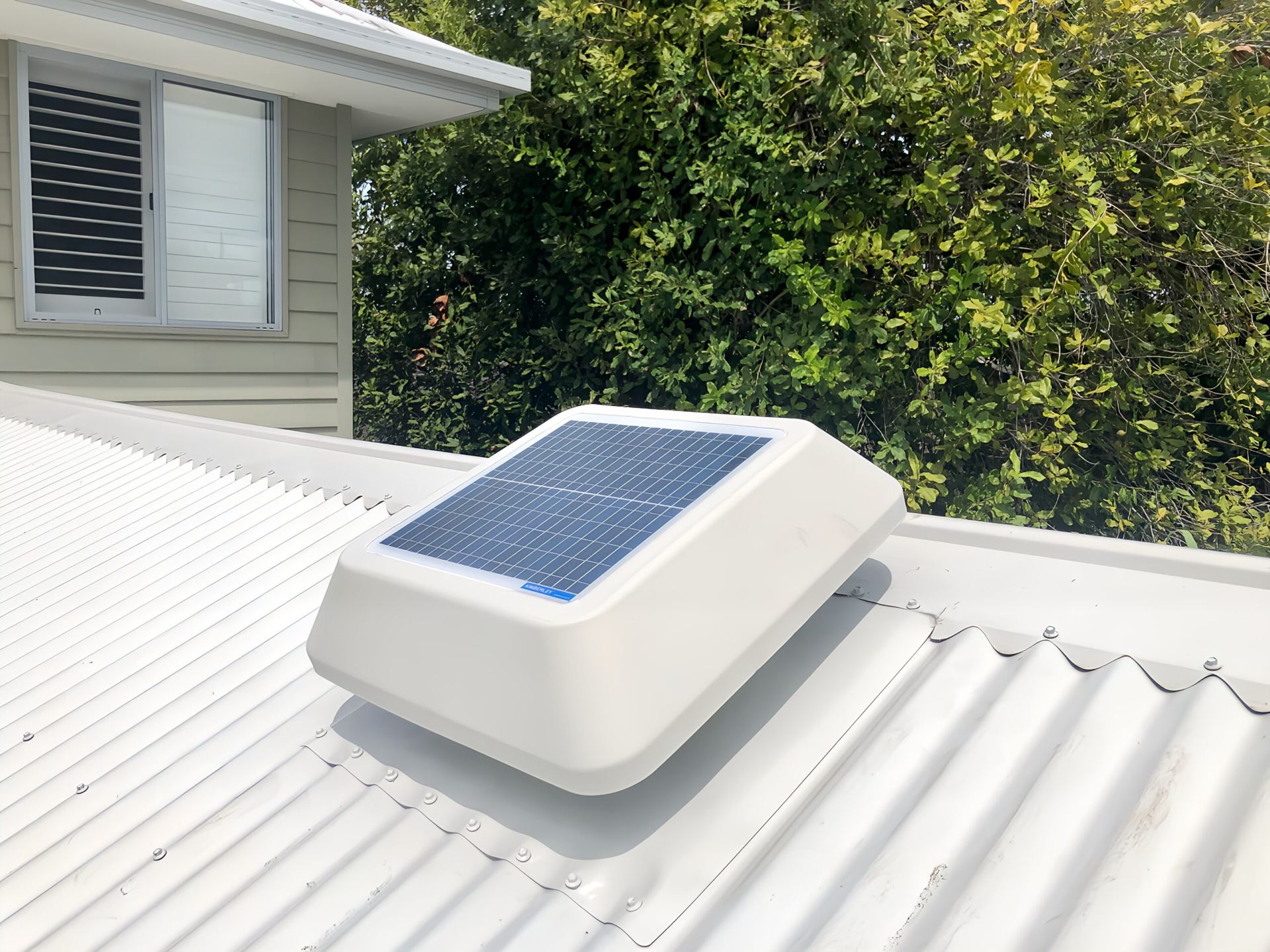
Sol Coast Construction supplies and installs the Australian-made Kimberley KSV300 solar roof ventilator across the Sunshine Coast, from Gympie to Bribie Island, on Colorbond and tiled roofs, from $900 installed, in three models: the solar-only KSV300, the KSV300AC that blends in mains power and keeps running at night, and the app-controlled KSV300SM. It runs on sunlight, so it works hardest when your roof is hottest, and it goes into the same opening as most whirlybirds. Licensed carpenter, QBCC licensed and insured, Kimberley warranty of 24 months on the motor and 5 years on the chassis, fixed written quote before any work starts.
Rated 5.0 from 95 Google reviews, every one of them five stars. The quotes through this page are from customers whose roof vents we installed.
Why a Sunshine Coast roof needs active ventilation
On a summer afternoon the air inside a Queensland roof cavity can pass 60 °C, and that heat has nowhere to go but down through the ceiling into the rooms you are trying to cool. If your air conditioning ducts run through the roof space, they are fighting that heat all day. In the humid months the same cavity traps moisture, which condenses on the underside of the roof and feeds mould in the insulation and the ceiling.
A whirlybird only moves air when the wind blows. On the still, hot days when you need it most, it barely turns. A solar roof ventilator is a powered fan that draws the hot, damp air out and pulls cooler air in through the natural gaps under your tiles and flashings, all day, every sunny day, without a cent of electricity.
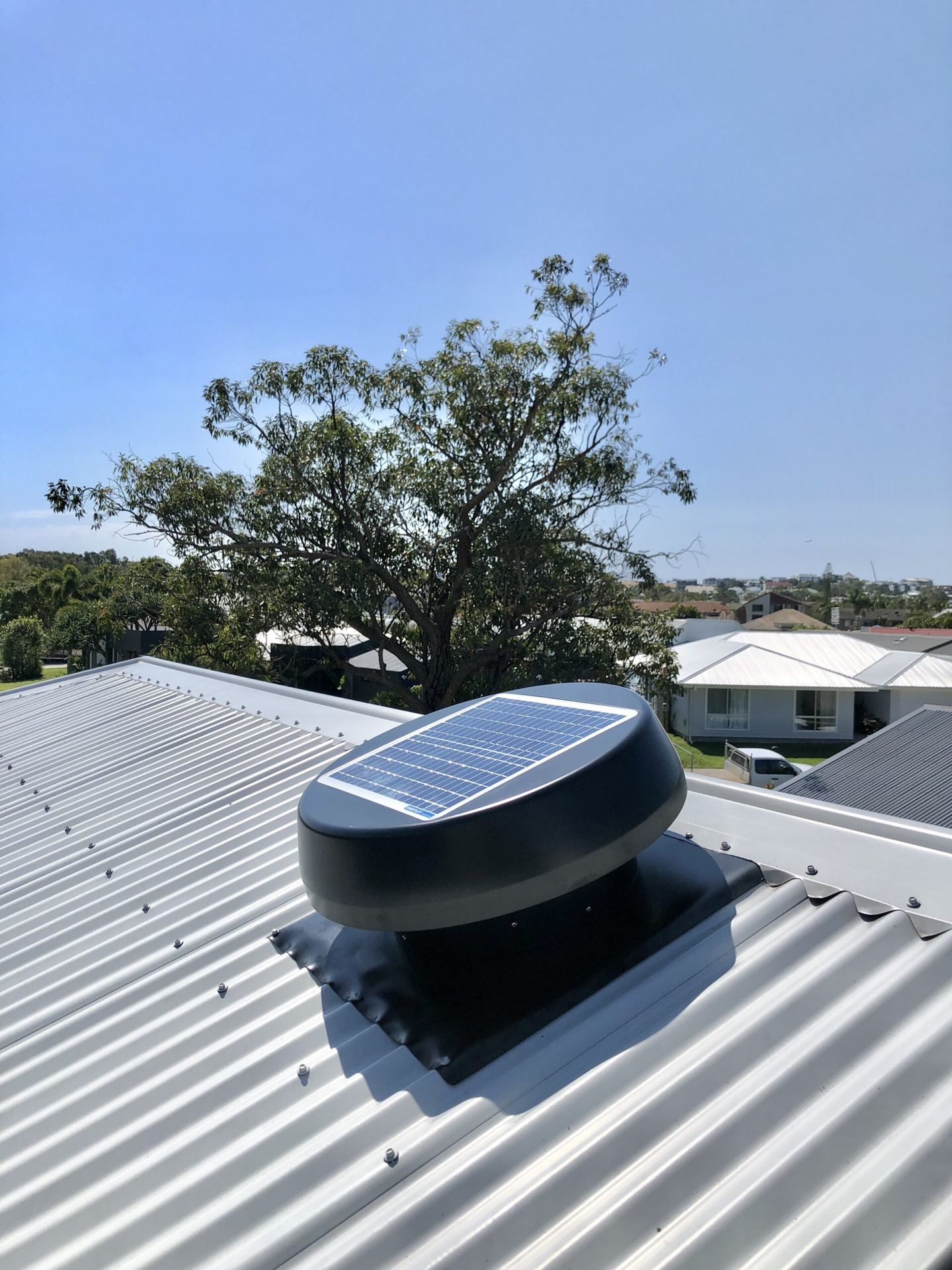
The Kimberley KSV300 at a glance
| KSV300 solar roof ventilator | |
|---|---|
| Made by | Kimberley Products, Australian family business since 1955 |
| Size | 600 mm wide, 600 mm deep, 225 mm high, round |
| Fan | 14-inch high-strength nylon multi-blade fan, non-corrosive |
| Motor | Brushless DC, IP68 waterproof, speed adjusts to the sunlight available |
| Power | Built-in tempered-glass solar panel, no wiring, no running cost |
| Thermostat | Cuts in around 28 °C, cuts out around 20 °C, so it rests in the cooler months |
| Covers | Up to 240 square metres of floor area under the roof |
| Roofs | Corrugated Colorbond and metal, and tiled roofs |
| Colours | Black or white, same price |
| Body | Rust-resistant galvanised steel chassis |
| Warranty | Kimberley: 24 months on the motor, 5 years on the chassis, plus our workmanship warranty |
Illume, Kimberley's own brand, rates the solar ventilator at up to ten times the efficiency of a wind-driven turbine. The part that matters most on the Coast is the brushless motor: there are no bearings to fail, so it does not develop the rattle that every ageing whirlybird eventually gets, and it keeps running at full capacity year after year.
KSV300, KSV300AC or KSV300SM: which model?
All three are the same Kimberley roof unit, with the same panel, fan, motor and 240 square metre coverage. They differ only in how they are powered and controlled.
| KSV300 | KSV300AC | KSV300SM | |
|---|---|---|---|
| Power | Built-in solar panel only | Solar first, mains blended in as the light drops, mains at night | Solar panel, with app control |
| Runs at night | No, stops at dusk | Yes, on mains power | Ask us; it pairs with the night-running option |
| Controls | Fixed thermostat: on at about 28 °C, off at about 20 °C | Remote control: on, off and a timer | Smart Life app: fan speed, temperature and humidity triggers, schedule |
| Electrical work | None | A standard 413 socket in the roof space; a licensed electrician adds one if there is none within reach | Confirmed in your quote |
| Best for | Most homes: roof heat and mould, no running cost | Overnight purging; a bathroom, garage or robe that needs extraction after dark | Owners who want to set when and how hard it runs |
| Price | From $900 supplied and installed | Written, fixed quote | Written, fixed quote |
Jump to: KSV300 · KSV300AC · KSV300SM
Kimberley KSV300 (solar only)
The KSV300 is the standard model and the one most Sunshine Coast homes need. It runs entirely on its built-in solar panel: no wiring, no electrician, no running cost. The thermostat starts it at about 28 °C and stops it at about 20 °C, and the fan speed rises and falls with the sunlight, so it works hardest on the hottest afternoons and rests through winter. It slows at dusk and stops for the night, which is when the roof is coolest anyway. From $900 supplied and installed, in black or white at the same price.
Kimberley KSV300AC (solar plus mains, runs at night)
The KSV300AC is the same roof unit fitted with Kimberley's AC power supply kit (part KSVAC01) and a remote control. Kimberley's own brochure lists this combination as the KSV300RC; retailers sell it as the KSV300AC. It uses all available solar power first, blends in mains power as the light drops, and when there is no sun at all it runs on mains to hold the fan speed, so the roof keeps purging through the night. The remote turns it on or off and sets a timer.
It plugs into a standard 413 socket in the roof space, the same socket a downlight uses. If there is not one within reach, a licensed electrician adds one. Ducted to a bathroom, the KSV300AC can take the place of a tired ceiling extraction fan and plug into that fan's existing socket. Choose it if you want the roof purged overnight, or for a bathroom, garage or walk-in robe that needs extraction after dark.
Kimberley KSV300SM (Smart Life app)
The KSV300SM is the app-controlled model. It connects to the Smart Life app on your phone, where you set the fan speed, the temperature and the humidity it responds to, and a schedule, instead of leaving it to the fixed thermostat. Choose it if you want to run the unit harder on humid days to keep mould down, or decide exactly when it runs. Tell us when you enquire if you also want it running after dark, and the quote covers the right combination.
Solar roof ventilator or whirlybird?
| Whirlybird | Kimberley KSV300 | |
|---|---|---|
| Runs on | Wind | Sunlight |
| Still 34 °C afternoon | Barely turns | Running at full speed |
| Overcast day | Depends on the breeze | Runs at reduced speed |
| Winter | Spins whenever it is windy, pulling warmth out | Thermostat keeps it off below about 20 °C, keeping warmth in |
| Noise | Bearings wear, then it rattles | Brushless motor, quiet |
| Moisture and mould | Only if the wind cooperates | Purges the cavity every sunny day |
| Running cost | None | None |
If you have a whirlybird today, our guide to whirlybird replacement on the Sunshine Coast walks through the swap in detail.
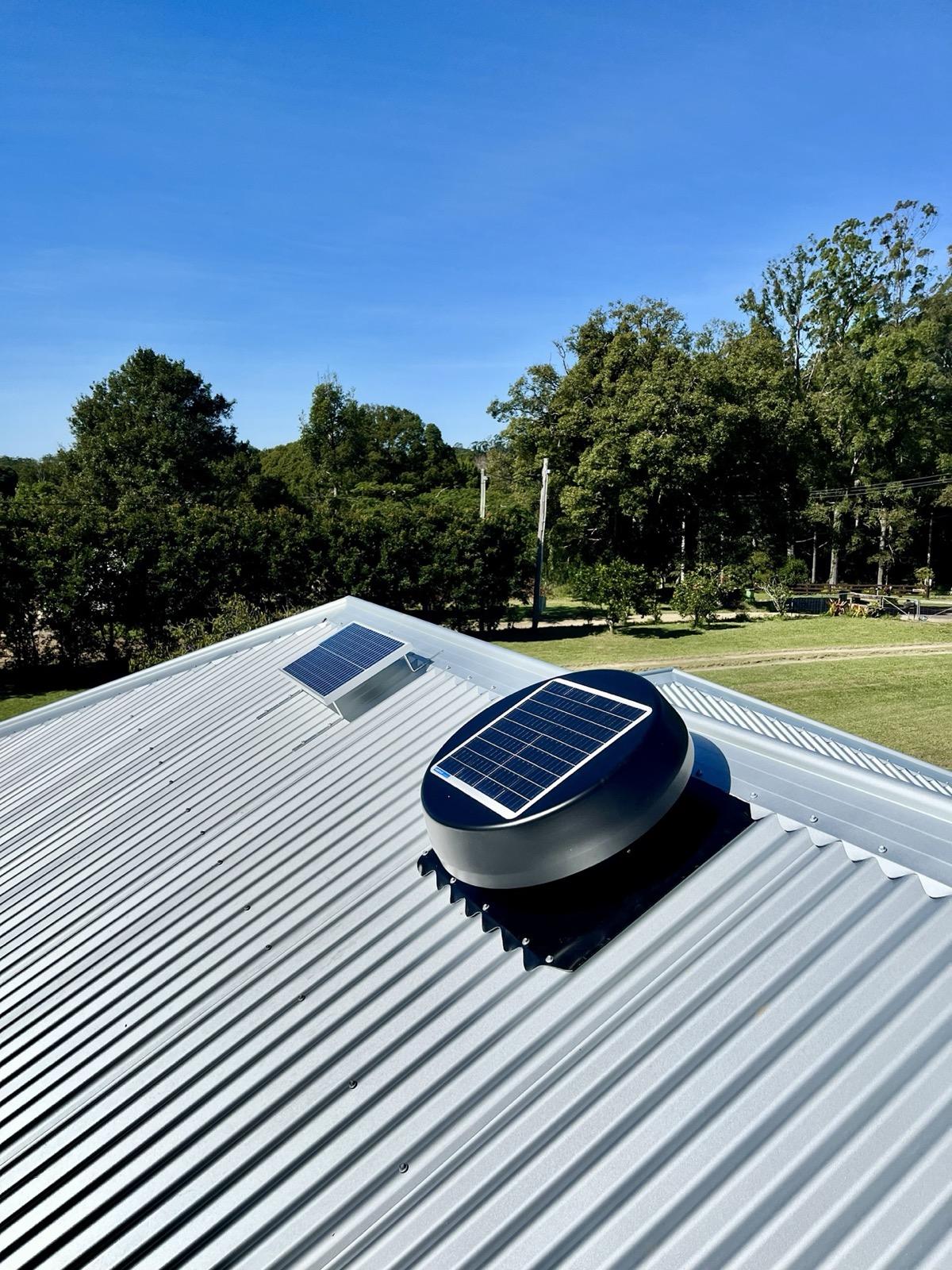
Three easy steps
- Ask for a quote. Most quotes do not need a site visit. Tell us the suburb, whether the roof is tile or Colorbond, roughly the size of the home, and whether there is a whirlybird up there now, and we send you a written, fixed quote.
- We book you in. Units are often in stock, and most installs happen within two to six weeks of your go-ahead. We confirm the best position on the day: north-facing and unshaded, so the panel sees the sun all day.
- Install day. On a Colorbond roof the flashing slides up under the ridge capping and the unit is screwed to the battens and sealed. On a tiled roof we lift a few tiles, fix the unit to the battens, trim the tiles back around it and seal the edges. We work from a fall-restraint system, so there is no scaffolding on your lawn, and the old whirlybird leaves with us at no extra cost.
“Installation of an illume skylight and solar vent was literally a breeze, and there was no extended waiting time. Everything happened a lot quicker than we expected!” Anita Burton, Google review
Replacing a whirlybird with a KSV300
Most whirlybird swaps use the existing roof opening with little or no modification, on metal or tiled roofs. The one rule is the sun. A solar ventilator needs a north-facing position, so if your whirlybird sits on a southern slope we fit the new unit on the north side and deal with the old one in whichever way suits your roof: remove it and sheet or tile over the opening, or cap it with a roof sheet. We advise on the day and the quote covers it.
“No question is too silly, no request too much and he doesn’t sales pitch you but give sound advice sometimes doing himself out of a job.” Belinda Hayes, Google review
Ducting and eave vents
- Runs after dark, or by app. The standard KSV300 stops at dusk. The KSV300AC keeps running on mains power overnight, and the KSV300SM is controlled from the Smart Life app; both are covered above.
- Ducted to a room. With Kimberley's 400 mm solar vent duct kit (part KSVADKR020, 2 m long) the KSV300 draws air from a specific room rather than the roof cavity: a garage, a bathroom or a walk-in robe. In a bathroom the KSV300AC can take the place of a tired ceiling extraction fan, plugged into the fan's existing socket. A four-way ceiling splitter lets one unit serve several rooms. A ducted unit no longer ventilates the roof space itself, so many homeowners install two: one for the roof, one for the room.
- Eave vents. Most roofs do not need them. A roof already breathes through the gaps under the tiles and flashings, and the opening a handful of eave vents adds is small by comparison. Kimberley's eave vent is a 150 × 75 mm louvre (part KSVAEVW010). We can fit them if you want them; ask when you enquire.
“We had a KSV300 solar roof vent installed today by Michael. His quote to supply and install was very competitive, and all the work was completed on schedule and with a minimum of fuss. He even had time to offer advice about how to cool our garage too.” Wally Beadman, Google review
What it costs
A Kimberley KSV300 supplied and installed starts from $900 on the Sunshine Coast. The price moves with a second storey, a tiled roof, a second unit or a ducting kit, and every quote is written and fixed before we start, so the figure you accept is the figure you pay.
“Micheal recently installed 2 solar roof vents. He provided an excellent service, including a very competitive quote and professional installation of the vents.” Marion Williams, Google review
Where we install
Sunshine Coast, Gympie to Bribie Island, and North Brisbane: Noosa, Coolum, Maroochydore, Mooloolaba, Buderim, Nambour, Caloundra, Birtinya and the hinterland in between. Each of those pages covers the roofs and the questions of that area.
What customers say
“Michael is very professional. The workmanship is excellent. Michael installed two solar vents, excellent product, ventilating our roof and garage. We would highly recommend Michael.” Steve Butler, Google review
“We highly recommend Michael who installed a solar roof ventilator for us. He was prompt, professional and friendly. He even showed us photos of the installation process as he was on the roof.” Karen Treleaven, Google review
“Michael from SOL Coast Constructions couldn't be faulted with his supply & installation of Ilume Skylight & Solar Roof Ventilator. Quote & service delivered as promised. Competitive pricing.” BG Campbell, Google review
Read all our reviews on Google
Solar roof ventilation questions, answered
Do solar roof ventilators actually work?
Short answer: Yes. A powered fan moves far more air than a wind turbine, and it runs exactly when the roof is hottest.
Detailed: A solar ventilator is a fan, not a spinning cap. The KSV300's solar panel drives a brushless motor whose speed rises with the sunlight, so on a clear 34 °C afternoon it is running flat out, drawing the hot air out of the cavity and pulling cooler air in through the gaps under the tiles and flashings. Illume rates it at up to ten times the efficiency of a wind-driven turbine. The result you notice is a ceiling that is no longer radiating heat into the room in the late afternoon.
Is a solar roof ventilator worth it on the Sunshine Coast?
Short answer: For a home with a hot roof space, ducted air conditioning in the roof, or a mould problem, yes.
Detailed: The Coast gives a solar ventilator everything it needs: long sunny days, a hot roof cavity for most of the year, and humid air that condenses in the roof overnight. If your upstairs rooms are hot in the evening, your air conditioning ducts run through the roof, or you have seen mould on the ceiling or in the insulation, a KSV300 pays for itself in comfort and in lower cooling load. If the roof is already well insulated and the house stays cool, the gain is smaller.
How many solar roof ventilators does my home need?
Short answer: One KSV300 covers up to 240 square metres of floor area. Most homes need one; larger homes may need two.
Detailed: The number depends on the size of your floor plan and the pitch of the roof. For most small to medium homes a single, centrally placed unit on the north side is enough. Larger homes, or homes with two separate roof cavities, may need two, placed to cover each end of the roof. We confirm the count in the quote.
How much does a solar roof ventilator cost installed?
Short answer: From $900 supplied and installed on the Sunshine Coast.
Detailed: The from-price covers a KSV300 on a single-storey roof. A second storey, a tiled roof, a second unit or a ducting kit move the figure, and the quote is written and fixed before any work starts.
Does a solar roof ventilator work at night or on cloudy days?
Short answer: It runs at reduced speed under cloud and stops at night; the KSV300AC keeps running on mains.
Detailed: The fan speed follows the light, so on an overcast day the KSV300 keeps running, just more slowly. After dark the standard unit stops, which is when the roof is coolest anyway. If you want it running overnight, in a bathroom for example, the KSV300AC draws on mains power when the sun is not there.
What is the difference between the KSV300 and the KSV300AC?
Short answer: The KSV300 runs on solar only and stops at night. The KSV300AC adds Kimberley's AC power kit and a remote, so it blends in mains power and keeps running after dark.
Detailed: Both are the same roof unit: the same solar panel, 14-inch fan, brushless IP68 motor and 240 square metre coverage. The KSV300AC (Kimberley's brochure calls it the KSV300RC) uses every watt of solar first, blends in mains as the light drops, and holds its fan speed on mains when there is no sun. Its remote turns it on or off and sets a timer. The only extra it needs is a 413 socket in the roof space. Pick the KSV300 for a cooler roof on sunny days at no running cost; pick the KSV300AC if the roof, a bathroom or a garage needs extracting through the night.
Does the KSV300AC need an electrician?
Short answer: Only if there is no 413 socket within reach in the roof space. The unit plugs into a standard 413 socket, the same one a downlight uses.
Detailed: Many roof spaces already have a 413 socket near the ceiling lights, and the KSV300AC simply plugs in. If there is none within reach, a licensed electrician fits one; we flag that in the quote so there are no surprises. Ducted to a bathroom, the unit can reuse the socket of the ceiling extraction fan it replaces.
What does the KSV300SM Smart model do?
Short answer: It connects to the Smart Life app, where you set the fan speed, the temperature and humidity it responds to, and a schedule.
Detailed: The standard KSV300 follows a fixed thermostat. The KSV300SM puts those decisions on your phone: run it harder on a humid day, set a lower cut-in temperature, or run it on a schedule. The roof unit, panel, motor and coverage are the same as the KSV300. Ask when you enquire if you also want it running after dark.
Is a solar roof ventilator noisy?
Short answer: Quiet. The brushless motor has no bearings to wear, so it never develops a whirlybird's rattle.
Detailed: You may hear the unit faintly from directly beneath it on a bright day when it is running at full speed, but it is a steady fan hum, not the clatter of a worn turbine. Kimberley designed the brushless motor specifically to remove the vibration and bearing noise that rotary vents develop as they age.
Does it run in winter and let the warmth out?
Short answer: No. The thermostat turns it off below about 20 °C, so winter warmth stays in the roof.
Detailed: The KSV300 cuts in at around 28 °C and cuts out at around 20 °C. In the cooler months it simply rests, so your ceiling insulation keeps the warmth where you want it. A whirlybird, by contrast, spins whenever the wind blows, summer or winter.
Will a solar roof ventilator stop mould and condensation in the roof?
Short answer: It removes the damp air that causes it, every sunny day.
Detailed: Condensation forms when warm, moist air cools against the underside of the roof. By purging that air through the day, a KSV300 keeps the cavity drier and takes away the conditions mould needs. It can also be ducted straight to a damp garage, bathroom or walk-in robe.
Do I need eave vents as well?
Short answer: Usually not. Most roofs already draw in enough air under the tiles and flashings.
Detailed: A roof is not sealed: air comes in under every tile, flashing and ridge, and that is where the ventilator draws its make-up air. The opening a few eave vents add is small by comparison, so we rarely fit them. If you want them, we can install them on the same visit; mention it when you enquire.
Does the KSV300 fit a tiled roof and a two-storey home?
Short answer: Yes to both. It suits corrugated and tiled roofs, and a second storey only changes the price.
Detailed: On tiles we lift a few tiles, fix the unit to the battens and trim the tiles back around the malleable base. On Colorbond the flashing slides under the ridge capping. Two-storey homes are installed from a fall-restraint system without scaffolding.
Does the KSV300 come in white as well as black?
Short answer: Yes. Black or white, same price.
Detailed: Black is the most common choice, but many Sunshine Coast homes are finished in light Colorbond tones such as Surfmist. In white the unit blends with a light roof instead of standing out on it.
Can a KSV300 replace my existing whirlybird?
Short answer: Yes, in the same opening if the whirlybird faces north; otherwise we fit it on the north side.
Detailed: A solar ventilator must see the sun, so a whirlybird on a north-facing slope is replaced in place with little or no modification. If yours is on the south side, we install the KSV300 on the north slope and either remove the whirlybird and close the opening or cap it with a roof sheet. We remove and dispose of the old unit at no extra cost.
Will the installation leak?
Short answer: No. The unit is flashed under the ridge or tiled in, screwed to the battens and sealed.
Detailed: On Colorbond the top flashing sits up under the ridge capping, out of the weather, and the edges are sealed. On a tiled roof the tiles are trimmed to sit over the base and the joints are siliconed. The unit itself is rated IP68 waterproof, and we warrant our workmanship as a QBCC-licensed contractor.
What warranty does the KSV300 come with?
Short answer: Kimberley warrants the motor for 24 months and the chassis for 5 years, and we warrant the installation.
Detailed: Kimberley Products' solar ventilator warranty covers defects in materials and workmanship for 24 months on the motor and 5 years on the chassis from the purchase date, and Kimberley repairs or replaces at its cost. Sol Coast Construction warrants the installation as a QBCC-licensed contractor. In the rare event of a fault we deal with it directly, so you never have to chase the manufacturer yourself.
How long does it take to get one installed?
Short answer: Usually two to six weeks from your go-ahead, and the install itself is a single visit.
Detailed: We quote from your details without a site visit in most cases, and we often have units in stock. Once you accept the quote we book a date, and the job is finished on the day.
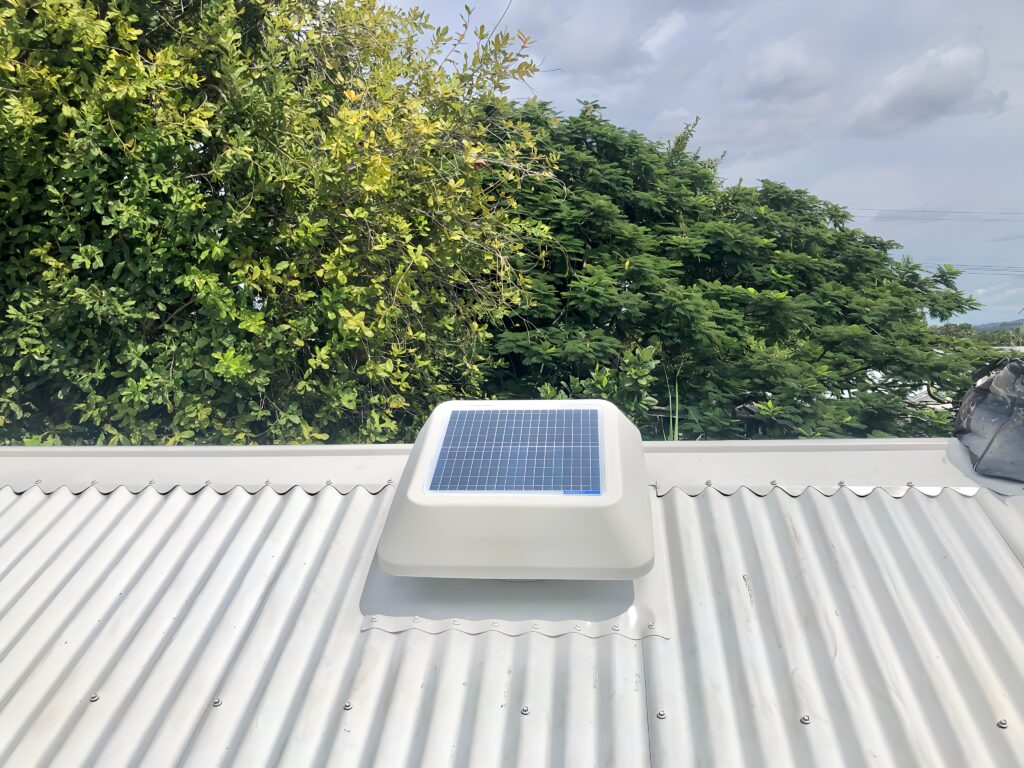
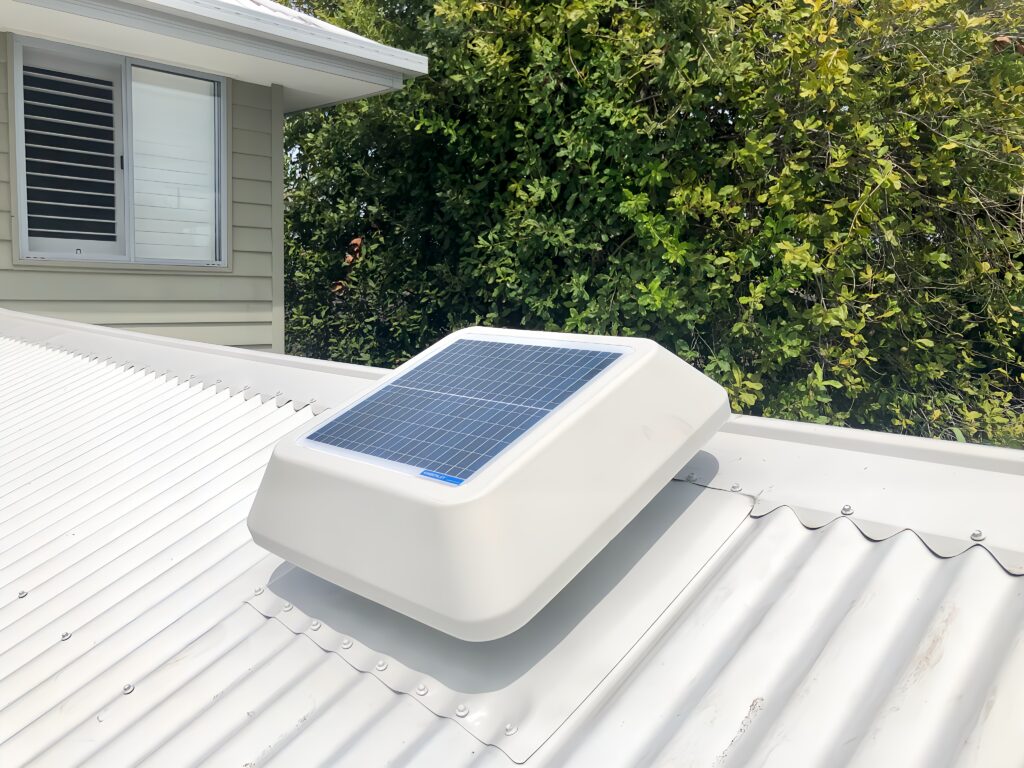
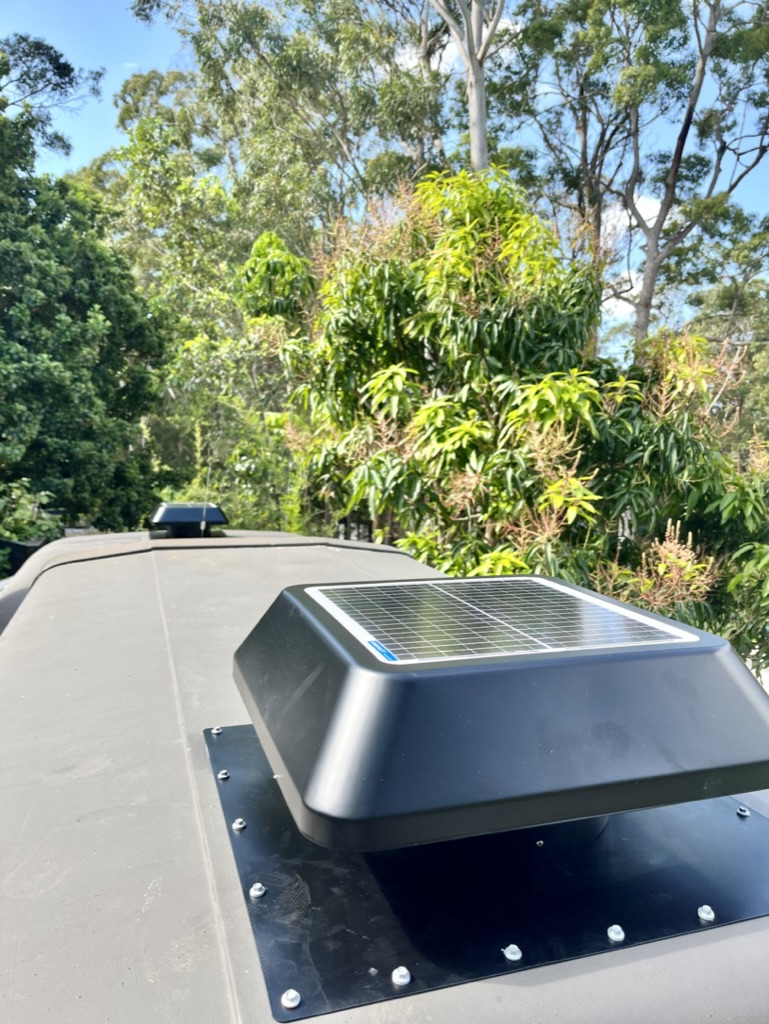
Pairing a ventilator with a Kimberley attic ladder turns a cooler roof space into usable storage, and a roof screw replacement is easily done on the same visit.
“Michael is a meticulous tradesman. He has installed a manhole, insulation, and solar vents for us. Highly recommend him.” Gretta Evans, Google review